



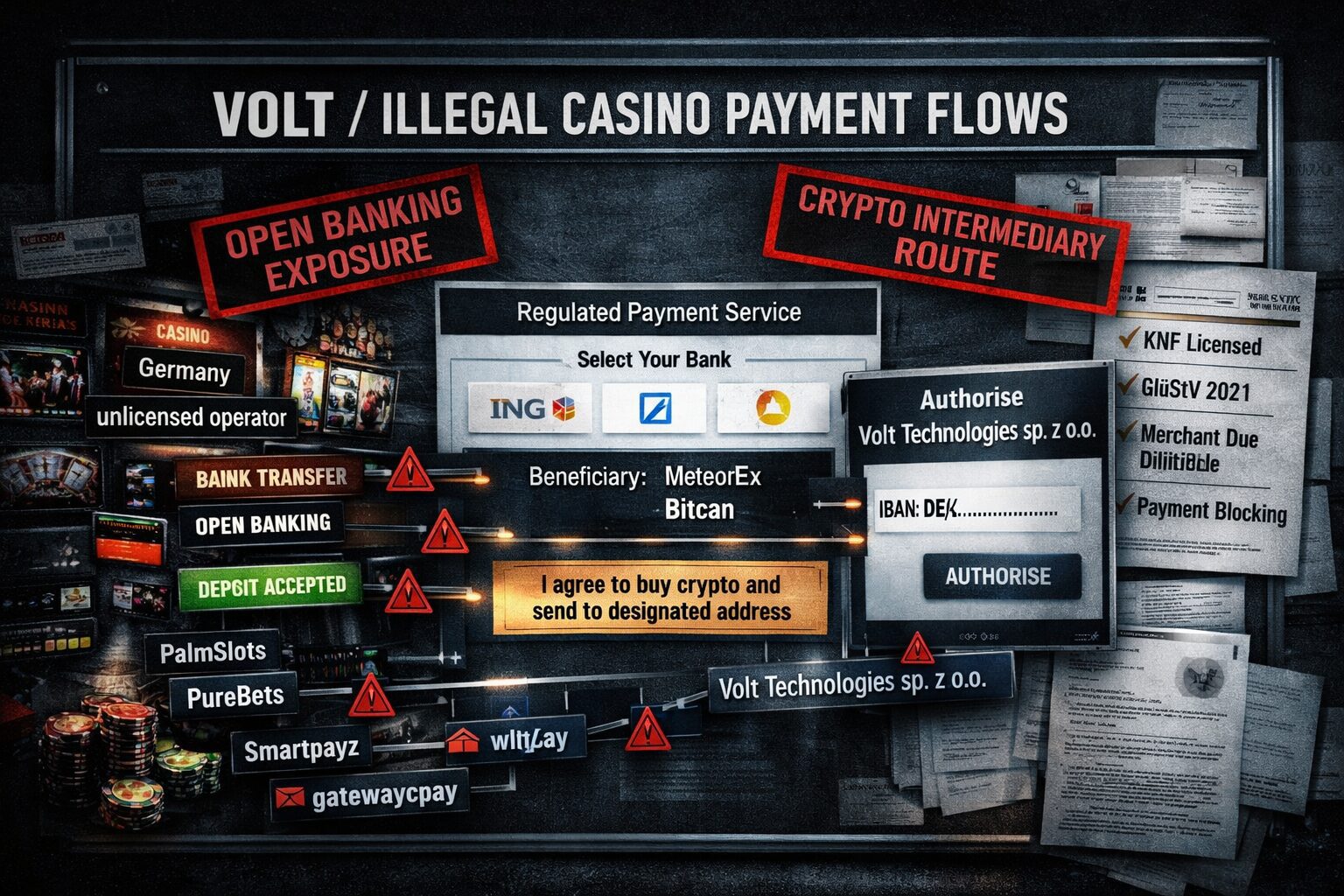
Volt, a KNF-licensed open-banking provider backed by top-tier investors appears in recorded deposit flows for illegal offshore casinos targeting users in Germany. FinTelegram’s review shows Volt’s checkout embedded in payment journeys routed through crypto-linked intermediaries, raising hard questions about merchant due diligence, payment blocking under German gambling law, and the compliance perimeter for regulated PISPs.
Key Findings
- Volt Technologies sp. z o.o. is authorised by the Polish Financial Supervision Authority (KNF) as a National Payment Institution under entity ID 635816.
- Volt’s current corporate materials identify Steffen Vollert as CEO, while the group’s funding rounds include a $23.5 million Series A in 2021 and a $60 million Series B in 2023.
- In deposit flows reviewed by FinTelegram, checkout.volt.io appears inside Germany-facing casino deposit journeys, with MeteorEx and Bitcan shown as beneficiaries rather than the casino itself.
- Volt’s own end-user terms state that, for some merchants, a Volt-initiated payment may be made to a merchant provider rather than directly to the merchant.
- German gambling law expressly prohibits participation in payments connected with unauthorised gambling, and German courts have upheld payment-blocking measures against payment providers, including a case involving a Zahlungsauslösedienst.
The Question
How does a deposit to an illegal offshore casino end up as an open-banking payment authorised by a payment institution licensed by the Polish Financial Supervision Authority?
That is the central compliance question raised by two deposit flows reviewed by FinTelegram. In both, the user starts on an offshore casino front-end accessible from Germany. In both, the payment path runs through gateway layers before landing on checkout.volt.io, where Volt appears as the payment-initiation layer. And in both, the beneficiary shown on the Volt checkout is not the casino, but a crypto-linked intermediary.
Read our reports on Volt here.
Why Volt Matters
Volt is not some obscure back-office vendor. Public records show that Volt Technologies sp. z o.o. is a KNF-authorised Krajowa Instytucja Płatnicza / National Payment Institution, and Volt’s own regulatory page says the Polish entity is used for its regulated European activity. Companies House also shows the group structure through Volt Technologies Holdings Limited and Volt Technologies Limited, both registered at 42 Berners Street, London. The FCA register shows Volt Technologies Limited as an authorised EMI, and Volt’s own user terms identify FCA firm reference number 982594.
Volt’s current “About” page identifies Steffen Vollert as CEO and lists major milestones including the Polish payment-institution licence in August 2023 and the UK EMI licence in February 2024. Volt’s public announcements also confirm a $23.5 million Series A led by EQT Ventures in 2021 and a $60 million Series B led by IVP in 2023, with participation from CommerzVentures and existing backers.
That regulated status is not the problem. The problem is the use case.
The Regulatory Context In Germany
Germany’s Interstate Treaty on Gambling prohibits those involved in payment transactions from participating in payments for unauthorised gambling after prior notification of the unlawful offer. The English translation of the treaty also makes clear that the prohibition explicitly targets parties involved in the payment chain, including credit and financial service institutions.
The GGL’s enforcement posture has become more aggressive. Public reporting on the authority’s 2023 activity says it reviewed 1,864 websites and initiated 133 prohibition proceedings. Reporting on its 2024 activity states that it reviewed over 1,700 websites and initiated 231 prohibition proceedings.
The courts have also reinforced the payment-blocking model. In October 2023, the OVG Sachsen-Anhalt confirmed the legality of a prohibition relating to payment services for illegal gambling. The GGL itself cites that ruling as judicial confirmation of its approach. In December 2024, the same court issued a decision publicly described as a lawful payment-blocking order against a Swiss-based Zahlungsauslösedienst.
In plain terms, payment firms are now squarely inside the illegal-gambling enforcement perimeter in Germany.
The Observed Deposit Flows
FinTelegram reviewed two deposit recordings involving Germany-facing casino front-ends.
Flow A: PalmSlots
The first flow begins on a PalmSlots deposit interface, where the user selects an open-banking type payment option. The route then passes through cashier.smartpayz.com and tollgate.smartpayz.com, before reaching gate.wltpay.pro and then checkout.volt.io. On the Volt checkout, Germany is selected as the country and MeteorEx appears as the beneficiary. The user then proceeds toward bank authorisation.
Flow B: PureBets
The second flow begins on a PureBets deposit interface, where the user selects a “Bank Transfer” option. The route again passes through Smartpayz layers before reaching gatewaycpay.com. There, the user is shown a bank-selection step and a consent screen stating that they agree to buy crypto and send it to a designated address, with Bitcan Sp. z o.o. identified on that layer reviewed by FinTelegram. The user is then redirected to checkout.volt.io, where Bitcan Sp. z o.o. appears as the beneficiary.
These observations matter because Volt is not merely an invisible API in the background. In the reviewed flows, Volt’s checkout appears at the decisive payment-initiation stage, and the regulated Polish entity is identified on the authorisation layer reviewed by FinTelegram.
The Intermediaries In The Rail Map
MeteorEx S.r.o.
MeteorEx s.r.o. (ICO 21270244) is a Czech-registered company (registered 26 February 2024, 1-5 employees) operating meteorex.net, a cryptocurrency service provider. The website describes it as a platform for buying cryptocurrency using credit cards, bank transfers, Apple Pay, Google Pay, and other payment methods. MeteorEx positions itself as non-custodial and decentralised.
MeteorEx appears as the beneficiary on Volt’s checkout in Flow A. GloboPay UAB, a crypto exchange, publicly lists MeteorEx (meteorex.net) as one of its fiat payment service providers alongside Bitflow and Munzen. This suggests MeteorEx functions as a fiat-to-crypto on-ramp in the broader ecosystem.
Bitcan Sp. z o. o.
Bitcan Sp. z o.o. (KRS 0000808472, NIP 6292495068) is registered at ul. Jana Henryka Dąbrowskiego 77A, 60-529 Poznań. Board: Piotr Bień (Prezes Zarządu). The company operates bitcan.pl, a cryptocurrency exchange offering buying, selling, and withdrawal services, including at over 100 stationary locations. It uses biometric identity verification and AI-based transaction monitoring.
Bitcan is wholly owned by ARI10 Sp. z o.o., a Polish crypto holding whose products include the ARI10 token, a payment gateway (ARI10 Gateway), and crypto POS terminals (Cryptoterminal). ARI10’s co-founders include Mateusz Kara (CEO) and Piotr Bień, who also serves as Prezes Zarządu of Bitcan. FinTelegram has published a separate investigation into the ARI10/Bitcan gateway, documenting how “Bank Transfer” casino deposits are converted into stablecoin on-ramps through ARI10’s infrastructure.
Bitcan appears as the beneficiary on Volt’s checkout in Flow B, where the user explicitly consents to buying crypto and sending it to a designated wallet address. On the gatewaycpay.com consent screen, Bitcan Sp. z o.o. is named as the entity processing the data and conducting the crypto sale.
Smartpayz
Smartpayz (smartpayz.com) operates as a payment cashier and orchestration gateway. It appears in both flows as the first redirect layer after the casino deposit UI. The entity has been rated Black (Critical Risk) by RatEx42 in partnership with FinTelegram (February 2026), which confirmed a “Ghost Entity” status: no verifiable legal existence in UK Companies House or any major financial registry. The investigation found Smartpayz to be deeply integrated into the payment stacks of major offshore gambling groups.
wltpay.pro
wltpay.pro (gate.wltpay.pro) appears in Flow A as a payment processing/redirect layer between Smartpayz and Volt’s checkout. It displays a generic “We are processing your transaction” screen. The domain appears to be a white-label payment gateway. No public corporate registration has been identified for this entity.
gatewaycpay.com
gatewaycpay.com appears in Flow B as an additional orchestration layer between Smartpayz and Volt. It displays a bank selection screen and, critically, a consent form that names Bitcan Sp. z o.o. and includes an explicit checkbox: “I agree to buy crypto and send to the designated address.”
That is exactly the kind of layered structure regulators tend to examine closely.
The Merchant-Due-Diligence Issue
Volt’s own EU Merchant Services Agreement states that Volt makes the solution available to merchants for integration into their websites, and that Volt may suspend access if the use may be fraudulent, unlawful, or expose Volt to liability or breach applicable laws.
Volt’s own End User Terms go further and state that, for some merchants, a Volt-initiated payment may be made to a merchant provider rather than directly to the merchant.
The EBA’s published Q&A 2021_6048 also captures the merchant-facing AML/CDD logic behind the PISP model, stating that PISPs are not expected to conduct CDD on both the payee-customer and the payer at the same time, and referencing the online merchant as the customer in that context.
That does not, by itself, prove a due-diligence failure. But it sharpens the real compliance question:
Who exactly did Volt onboard in these flows, and what downstream use case was represented at onboarding and during ongoing monitoring?
If the onboarded counterparty was an intermediary such as MeteorEx, Bitcan, or another merchant provider rather than the casino itself, then the next question becomes unavoidable: did Volt understand that its regulated payment-initiation rail was being used in practice to fund deposits originating on Germany-facing offshore casino front-ends?
Why Flow B Matters Most
Flow B is the strongest part of the evidentiary picture reviewed by FinTelegram.
The user starts from a casino payment option framed as a fiat transfer. But before reaching Volt’s checkout, the user is shown a consent layer stating that they agree to buy crypto and send it to a designated address. After that, Volt initiates the payment flow with Bitcan shown as the beneficiary.
That sequence suggests a functional pattern in which a “bank transfer” deposit on a casino front-end is transformed into a crypto-funding leg routed through an intermediary, while Volt provides the payment-initiation layer that moves the funds.
Even without alleging intent, that is the kind of architecture regulators dislike: the gambling operator is not the visible payee on the regulated payment screen, crypto conversion is introduced mid-flow, and the named beneficiary is an intermediary rather than the casino collecting the deposit.
The Operator Side
For Germany, the core legal issue is not whether an offshore casino front-end points to a Curaçao licence somewhere in its terms. The core issue is whether it is authorised in Germany.
German law prohibits payment participation for unauthorised gambling offers, and the GGL’s enforcement record shows that it has treated payment services as a practical enforcement chokepoint.
That makes the rail map more important than the marketing language on the casino site.
Why This Matters For Volt
Volt is a venture-backed, licensed payment institution with a merchant-facing open-banking model. Its infrastructure is designed for regulated real-time payments, not for plausible deniability inside layered illegal-gambling deposit flows.
That is why its appearance in these flows matters. The pressure points are threefold.
- First, merchant onboarding and monitoring. If Volt onboarded an intermediary whose payment flow was being used, in practice, to fund Germany-facing illegal-gambling deposits, regulators will ask what was known, what should have been known, and what controls existed.
- Second, German gambling enforcement. The legal position has clearly shifted beyond the operator alone. The payment layer is in scope, and recent case law confirms that payment-blocking can reach even foreign payment initiators.
- Third, home-state supervision. Volt’s Polish entity is supervised by the KNF as a National Payment Institution. Questions about merchant due diligence, transaction monitoring, and the handling of high-risk or deceptive payment use cases therefore sit within a regulated supervisory perimeter, not just at the margins of gambling law.
8. Entities and Domains Observed
| Layer | Observed entity / domain | Role |
|---|---|---|
| Casino front-end | PalmSlots Purebets palmslots07.com, purebets436.com | Casino deposit interfaces reviewed in the recorded flows. Presented bank-transfer / open-banking style deposit options. |
| Gateway / cashier layer | Smartpayz cashier.smartpayz.com, tollgate.smartpayz.com | Upstream payment orchestration / redirect layer observed in both flows. Public legal-entity identification remains unclear based on ordinary public-source checks. |
| Additional gateway layer | gate.wltpay.pro | Intermediate processing / waiting page observed in Flow A before redirect to Volt checkout. Public corporate attribution remains unclear. |
| Additional gateway / consent layer | gatewaycpay.com | Intermediate orchestration layer observed in Flow B. In the reviewed flow, it displayed bank-selection and a consent step referring to crypto purchase and transfer to a designated address. |
| PISP / checkout layer | checkout.volt.io | Volt checkout layer where bank selection and beneficiary display occurred in the reviewed flows. Volt’s Polish regulated entity was identified on the bank-authorisation layer reviewed by FinTelegram. |
| Beneficiary / intermediary #1 | MeteorEx s.r.o. / meteorex.net | Crypto-linked service provider shown as beneficiary on the Volt checkout in Flow A, according to the reviewed recording. MeteorEx’s own site identifies ICO 21270244 and a Prague address. |
| Beneficiary / intermediary #2 | Bitcan Sp. z o.o. / bitcan.pl | Polish crypto company shown as beneficiary on the Volt checkout in Flow B, according to the reviewed recording. Public register data supports the Bitcan corporate identity. |
| Regulated payment entity | Volt Technologies sp. z o.o. | KNF-authorised Krajowa Instytucja Płatnicza / National Payment Institution. Entity ID 635816 in the KNF register. |
9. Summary Data: Volt.io
| Category | Details |
|---|---|
| Holding entity | Volt Technologies Holdings Limited (UK) |
| Holding registration | Companies House 12140559, 42 Berners Street, London, W1T 3ND. |
| Polish operating entity | Volt Technologies sp. z o.o., KRS 0000835557, NIP 6751727042, ul. Stefana Rogozińskiego 6, 31-559 Kraków. Public register sources show registration on 23 March 2020. |
| UK operating entity | Volt Technologies Limited, Companies House 14234292, 42 Berners Street, London, W1T 3ND. FCA register and Volt’s user terms support authorised EMI status. |
| Current senior leadership | Volt currently identifies Steffen Vollert as CEO. |
| Polish licence | National Payment Institution / Krajowa Instytucja Płatnicza, authorised by the KNF on 25 August 2023; entity ID 635816. |
| Funding | $23.5m Series A (2021) and $60m Series B (2023); investors publicly named by Volt include EQT Ventures, IVP, CommerzVentures, Augmentum Fintech, and Fuel Ventures. |
| Publicly claimed model | Volt markets itself as infrastructure for real-time account-to-account payments and merchant integration. |
| Observed role in reviewed flows | In FinTelegram-reviewed recordings, Volt’s checkout appeared as the payment-initiation layer in two Germany-facing casino deposit journeys, with MeteorEx and Bitcan shown as beneficiaries rather than the casino itself. |
Conclusion
The issue raised by these deposit flows is not whether Volt is licensed. It is.
The issue is whether a licensed open-banking payment initiator can credibly claim distance when its checkout is embedded in deposit journeys that begin on offshore casino front-ends, pass through opaque gateway layers, and end with payments to crypto-linked intermediaries instead of the gambling operator itself.
In the materials reviewed by FinTelegram, that is precisely the pattern. And in one of those flows, the user was explicitly told they were buying crypto and sending it to a designated address after selecting a casino bank-transfer option.
That is not a minor compliance detail. It is a rail-map problem with regulatory consequences.
Whistle42 Call for Information
If you have first-hand information, payment screenshots, gateway records, merchant documentation, onboarding materials, compliance correspondence, or internal knowledge about Volt, Smartpayz, gatewaycpay, wltpay, MeteorEx, Bitcan, or the payment rails behind Germany-facing offshore casinos, contact Whistle42 securely. FinTelegram welcomes documents, technical evidence, and insider information relevant to illegal gambling payment infrastructure and compliance failures.
Footnotes / Sources
- KNF register entry for Volt Technologies sp. z o.o., entity ID 635816.
- Volt regulatory page identifying the Polish entity as a KNF-regulated National Payment Institution.
- Companies House entry for Volt Technologies Holdings Limited.
- Companies House entry for Volt Technologies Limited.
- FCA register / Volt legal terms for Volt Technologies Limited and EMI status.
- Volt “About” page identifying Steffen Vollert as CEO and listing group milestones.
- Volt funding announcements: $23.5m Series A and $60m Series B.
- Public Polish register data for Volt Technologies sp. z o.o. showing address and registration date.
- German State Treaty on Gambling 2021, English translation, payment-participation prohibition.
- GGL / market reporting on 2023 and 2024 enforcement figures.
- OVG Sachsen-Anhalt 2023 and 2024 payment-blocking decisions; GGL enforcement page.
- EBA Q&A 2021_6048 on PISP AML/CDD logic.
- Volt EU Merchant Services Agreement.
- MeteorEx site / contact page.
- Volt End User Terms, including payments to a merchant provider.
- Bitcan register-backed corporate data and shareholder / management references.
- ARI10 leadership page.