

What happened:
The U.S. Justice Department (DOJ) unsealed an indictment in the Eastern District of Virginia charging Lai Kui Sen, co‑CEO of Ostin Technology Group Co. Ltd. (NASDAQ: OST), and Yan Zhao (aka “Hank Shi/Hank Shu”), a financial advisor, with orchestrating a $100+ million securities fraud scheme that targeted U.S. retail investors between April–June 2025. OST is a Cayman Islands company with its principal operations in China.
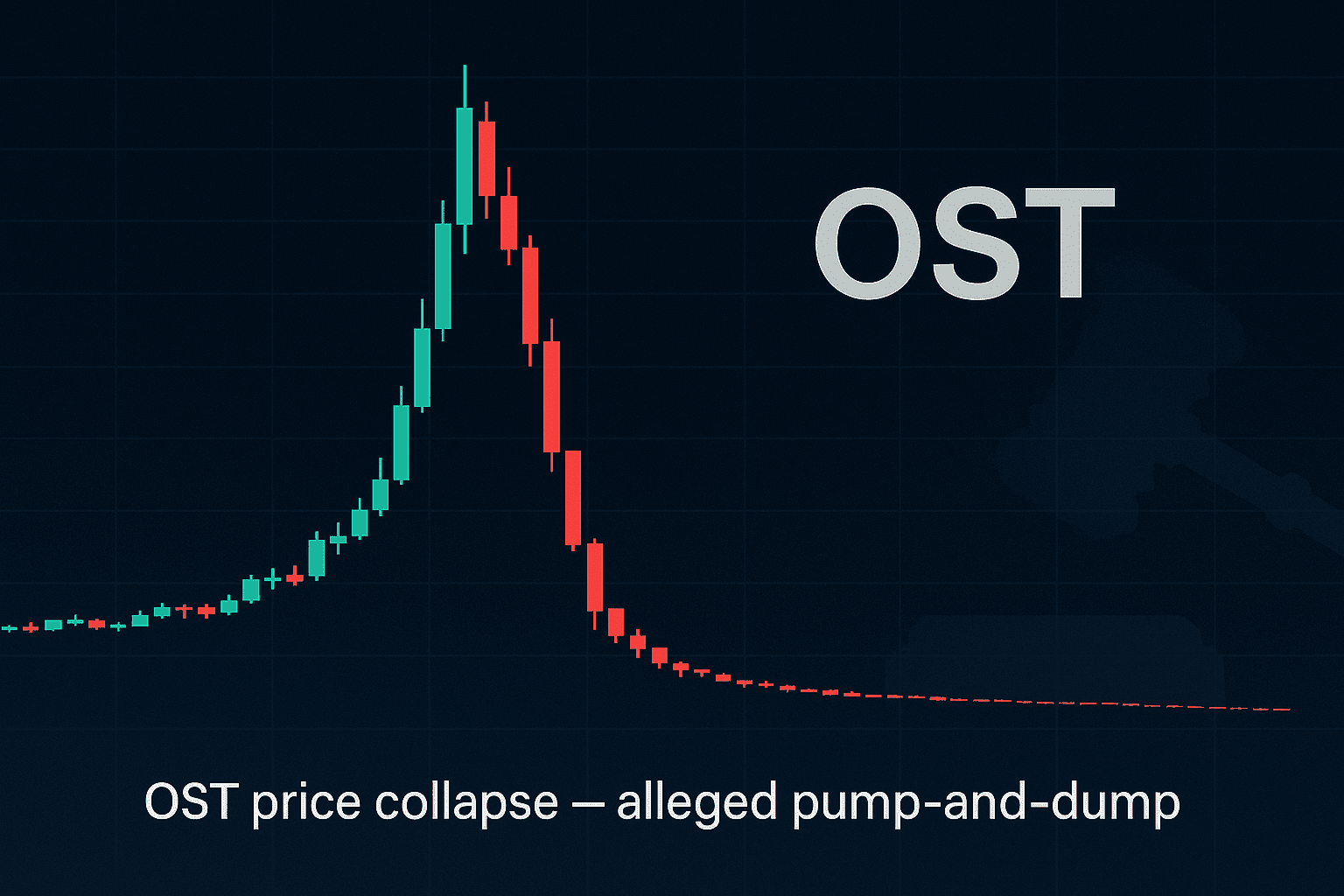
DOJ says the pair funneled tens of millions of OST shares to select insiders via non‑bona fide transactions—including one transfer of >70 million shares for no payment—then pumped the price through coordinated social‑media hype before dumping into the spike. On June 26, 2025, OST’s market cap allegedly collapsed by >94% (~$950 million). (Source: justice.gov)
Key points (why it matters):
- The scheme: Allocate cheap/zero‑cost OST stock to a tight circle; launch a deceptive social‑media “buying momentum” campaign (including impersonating investment advisers); dump into retail demand. Proceeds claimed: >$110 million.
- Charges: Conspiracy to commit securities and wire fraud; substantive securities fraud (Titles 18 & 15) and wire fraud. Max penalties: up to 25 years (Title 18 securities fraud) and 20 years for the other counts (per count). Sentencing will follow U.S. Guidelines (Sources: justice.gov+1).
- Issuer context: OST—a Cayman holding company with principal ops in China—previously used a VIE structure common to China‑based listings. NASDAQ‑listed.
- Market integrity note: DOJ says nearly $10 million has already been seized from co‑conspirators’ accounts; the FBI and SEC‑OIG investigated, with FINRA’s Market Abuse group providing a referral.
Short narrative (what regulators allege):
According to DOJ, Sen and Zhao first siphoned OST shares to about 15 co‑conspirators through two sham transactions. On April 15, 2025—the day the first discounted tranche landed—a fraudulent promo blitz kicked off to inflate price and volume. Brokerage accounts were opened for select investors to unload the paper into artificially stoked demand. When the music stopped, retail bag‑holders absorbed the damage as OST’s value cratered on June 26, 2025 (Source: justice.gov).
Regulatory/Enforcement angle (FinTelegram view):
- The case underscores a cross‑border enforcement push against social‑media‑driven microcap manipulation involving foreign issuers listed in the U.S. The involvement of SEC‑OIG and a FINRA surveillance referral signals deep market‑abuse tooling behind the scenes.
- Expect parallel civil action potential (SEC) and asset‑tracing to claw back proceeds. For platforms and promoters, impersonation and undisclosed paid hype remain high‑risk conduct that draws rapid attention from DOJ/FBI/SEC. (Inference based on DOJ language and prior practice.)
What’s next:
- Case posture: Indictment unsealed Sept 12, 2025 in EDVA. Defendants are presumed innocent; sentencing exposure is substantial if convicted. Monitor for detention, extradition issues, and any SEC parallel filing. justice.gov+1
- Issuer risk watchlist: Liquidity, trading halts, corporate disclosures, and any board/auditor updates should be tracked closely by investors and counterparties. (Market note.)
Call for information (FinTelegram):
Were you solicited to buy OST via social media, newsletters, or “advisor” messages between April–June 2025? Do you hold docs, chats, wallet trails, or payment receipts related to OST promotions or stock transfers? Contact FinTelegram confidentially. (Referencing DOJ’s victim notice page for affected investors.) justice.gov
Sources: U.S. DOJ Office of Public Affairs press release (Sept 12, 2025); U.S. Attorney’s Office, EDVA summary. justice.gov+1