



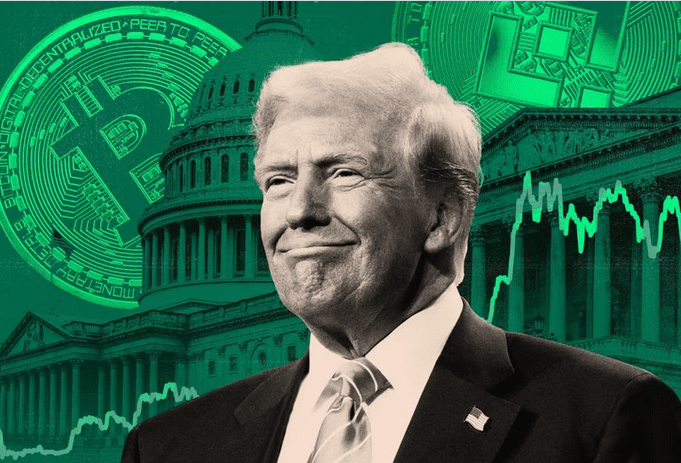
How the GENIUS Act turbo‑charges US-President Donald Trump’s on‑chain fortune—and why it matters!
On 18 July 2025 President Donald Trump signed the Guiding and Establishing National Innovation for U.S. Stablecoins Act—the “GENIUS Act”—heralding it as the “greatest revolution in financial technology since the birth of the internet.” The law gives dollar‑backed stablecoins a federal passport, demands 100 % cash‑or‑T‑bill reserves, and pointedly exempts the Oval Office from the very trading ban imposed on members of Congress. Critics call that carve‑out the most profitable line of legislative drafting since the 1872 Mining Act.
In a viral post, the investment writer @LogWeaver quipped that the president had just “signed himself a personal market‑maker license.”¹ Within hours the tweet sat atop Crypto‑Twitter’s trending feed, crystallising a deeper anxiety: when policy and portfolio merge, who is the regulator and who is the regulated?
Deconstructing Trump’s New Digital Fortune
| Digital asset | Ownership indicator² | Current ref. value | Implied Trump stake | Notes |
|---|---|---|---|---|
| USD1 stablecoin (World Liberty Financial) | ~40 % via DT Marks DeFi LLC (Source: Cointelegraph) | $2.20 bn mkt‑cap (Source: CoinMarketCap) | ≈ $0.88 bn | Stable $1 peg; interest on Treasury‑backed reserves accrues to issuer. |
| $TRUMP meme‑coin | Founder allocation undisclosed; token‑sale fees ~$320 m (Source: Reuters) | $2.30 bn mkt‑cap (Source: CoinMarketCap) | ≈ $0.09 bn (wallet estimate) (Source: Wikipedia) | Price up 8 % on GENIUS‑Act news. |
| Governance & “house” tokens (WLF ecosystem) | 15.75 bn units reported (Source: Reuters) | illiquid / not yet priced | Unknown upside | Give veto rights over reserve‑management & fee‑stream. |
| Token‑sale & licensing cash flow (2024) | — | — | $57 m income already booked (Source: Reuters) | Does not include 2025 surge. |
FinTelegram estimate: $1 billion+ of President Trump’s personal balance sheet is now crypto‑denominated—roughly 15 % of his $6–7 bn Forbes net‑worth tally.³ Last month alone, the White House reported more than $600 million in crypto‑linked income across the family empire
The Policy–Profit Flywheel
- Regulatory delta = market alpha
By legalising fully‑reserved stablecoins, the GENIUS Act converts USD1 from regulatory orphan to investment‑grade plumbing. Every retail dollar that lands in USD1’s reserves likely earns >5 % in Treasury yield—income that flows, pro‑rata, to a Trump‑controlled holding vehicle. - Liquidity pull effect
Major fintechs and banks have already signalled GENIUS‑Act settlement pilots. Axios forecasts stablecoin rails inside card networks within 18 months Axios. Wider adoption multiplies reserve float—and issuer profits—without expanding token supply. - First‑mover narrative premium
Meme‑coin investors trade on symbolism. A president‑endorsed token now carries a quasi‑sovereign mystique; the $TRUMP chart responded with a double‑digit spike the day the bill cleared the House X (formerly Twitter).
Trump, CZ, Saylor: Converging Paths to a Cyber‑Finance Elite
| Name (affiliation) | Flagship stack | Est. net worth | Key lever |
|---|---|---|---|
| Donald Trump (USD1 / $TRUMP) | Stablecoins, meme‑coin, policy | $6–7 bn (≈ $1 bn crypto) | Regulatory arbitrage—writes the rulebook he plays by. |
| Changpeng Zhao (CZ) (Binance) | Exchange, blockchain infra | $70 bn Forbes | Network effect—owns the rails, not the trains. |
| Michael Saylor (Strategy) | 214 k BTC + ETF sponsor | $11 bn Forbes | Balance‑sheet leverage—turned a software firm into a Bitcoin tracker. |
Hypothesis:
These actors anchor a post‑sovereign financier class in which capital, code and compliance collapse into a single stack. Trump provides the legislative cover; CZ the global on‑/off‑ramps; Saylor the institutional meme. Each sits atop a self‑reinforcing feedback loop:
Regulate → Monetise float → Accrue influence → Shape next rule set.
The playbook mirrors 19th‑century railroad barons—only this time the tracks are permissionless and the conductor lives in the White House.
What to Watch
- Treasury‑yield recycling: As USD1 reserves swell, will the Administration steer that demand toward specific T‑bill maturities, quietly influencing U.S. debt markets?
- Conflict‑of‑interest litigation: The GENIUS Act’s exemption for presidential holdings may face constitutional challenge; an injunction could freeze Trump’s stablecoin profits mid‑stream.
- Global copy‑trade: Expect politically connected leaders elsewhere to float “national” stablecoins—Bolsonaro‑coin? Modi‑Rupee?—using the U.S. template as safe cover.
- Secondary‑market pressure: If CZ lists USD1 alongside USDT and USDC, Binance liquidity could turbo‑charge adoption—but also concentrate systemic risk in a handful of private keys.
- Saylor’s next pivot: Strategy already holds >2 % of all bitcoin; will it tokenize T‑bills to compete—or join—USD1’s yield game?
Conclusion
The GENIUS Act is more than a stablecoin statute; it is a state‑sponsored equity kicker for the man who signed it. In fusing legislative power with tokenomics, President Trump has crossed the Rubicon from regulated to regulator‑capitalist—joining CZ and Saylor atop a new aristocracy of Cyber‑Finance. The question for markets and democracy alike is simple: Can anyone audit Caesar’s wallet?