



Executive Summary
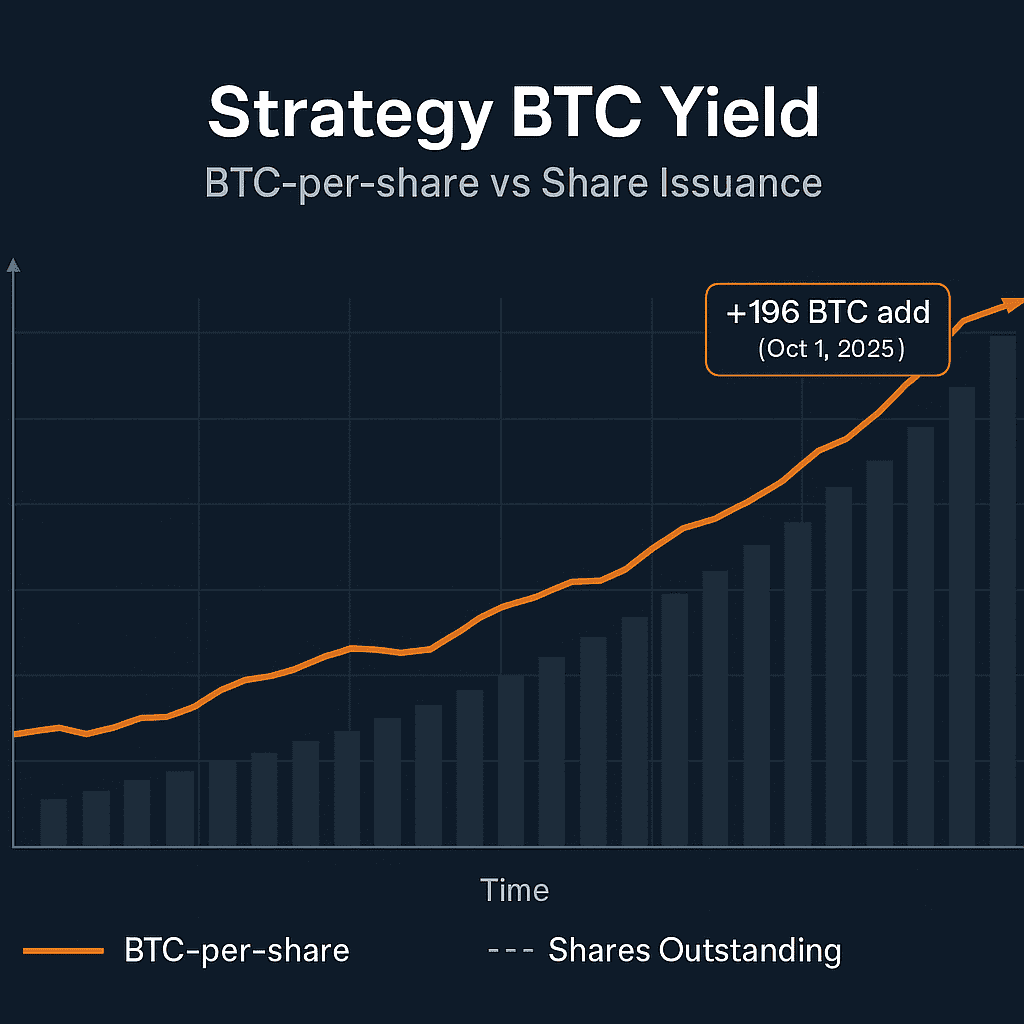
Strategy (formerly MicroStrategy) disclosed another purchase — 196 BTC for ≈approximately $22.1 million — reaffirming its role as the bellwether Bitcoin treasury company. But the firm’s key KPI, “BTC yield,” is decelerating as recent capital raises outpace net BTC deployed, with part of proceeds servicing preferred-stock obligations. For investors, the signal to watch isn’t the headline coins bought; it’s BTC-per-share (BPS) accretion and its rate of change (Source: CoinCentral).
What “BTC Yield” Actually Means
- Definition: BTC yield = the percentage change in Bitcoin-per-share (BPS) over a period. BPS is total BTC held divided by diluted shares outstanding. When BPS rises, each share “owns” more BTC; when issuance runs ahead of stacking, BTC yield slows (Source: Investopedia).
- Why it matters: Strategy’s equity/convertible playbook boosts BTC exposure, but share issuance can dilute BPS; only net BTC added per share drives long-term value for common holders. Management has even posted YTD “BTC yield” snapshots to underscore this KPI (Source: X (formerly Twitter))
Strategy’s BTC Treasury Playbook (as covered on FinTelegram)
- Mandate: Be a Bitcoin Treasury Company—raise capital (ATMs, converts, preferreds), buy BTC on dips, hold long term. Rebrand from MicroStrategy to “Strategy Inc” formalized the pivot (Source: Strategy).
- Recent cadence: Small, frequent buys (latest: 196 BTC @ ~$113k) sustain the stacking narrative but are modest vs. recent capital raised, pressuring BTC yield. Financial press calls this “dilution-as-a-strategy” when proceeds aren’t primarily deployed into BTC. (Source: CoinCentral).
Opportunities
- Embedded BTC beta with leverage: If BTC appreciates, Strategy’s equity historically amplifies upside due to balance-sheet gearing and narrative premium.
- Accounting tailwinds: Fair-value accounting (2025 adoption) reduces impairment drag and keeps reported BTC gains visible in GAAP results. (General context; monitor filings.)
Risks
- BTC-yield deceleration: When new equity/pref issuance > BTC deployed, BPS growth slows, weakening the core thesis for common holders. ft.com
- NAV-premium risk: If the stock’s premium compresses, cheap equity funding shrinks, limiting future stacking and potentially forcing slower accumulation. ft.com
Market Impact
Another add supports the corporate-treasury-in-BTC meme, but investors should track BPS, BTC yield (ΔBPS), financing mix, and NAV premium/discount—not just coin counts (Source: Bitcoin Treasuries).
Actionable Takeaways
- Watch BPS & BTC yield each quarter; treat headline “BTC bought” as secondary.
- Scrutinize funding use: If more cash goes to preferred dividends or opex than BTC, expect further yield slowdown.
- Positioning: Strategy is still the flagship BTC-treasurer. For pure BTC exposure, hold BTC. For levered BTC + equity optionality, hold MSTR—but size positions assuming yield volatility.