



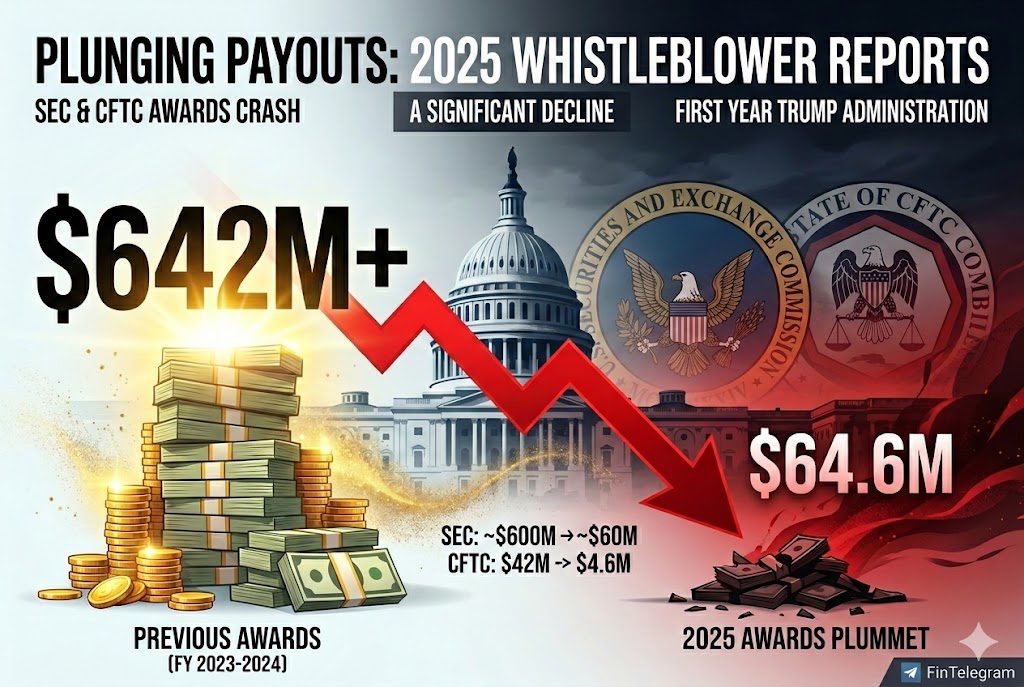
The recently released 2025 whistleblower reports from the SEC and CFTC reveal a dramatic decline in both the volume and value of awards granted. As payouts shrink to levels not seen in years, we analyze whether this staggering drop reflects a temporary administrative bottleneck or a fundamental shift in regulatory and compliance priorities under the Trump administration.
Key Findings: The 2025 Data at a Glance
The fiscal year (FY) 2025 reports submitted to Congress in February 2026 paint a stark picture of the current regulatory landscape for whistleblowers:
- SEC Payouts Plummet: The SEC awarded roughly $60 million to 48 individual whistleblowers in FY 2025. This is a dramatic drop from the $255 million awarded in FY 2024 and the record-breaking $600 million in FY 2023.
- CFTC Awards Stagnate: The CFTC approved only two whistleblower awards totaling $4.6 million in FY 2025. In FY 2024, the agency awarded $42 million to 12 whistleblowers.
- Record Tips vs. Record Denials: Despite the drop in awards, the SEC received approximately 27,000 tips (an 8% increase year-over-year). Conversely, the SEC issued over 120 award denials, reaching a denial rate that spiked above 80% at points during the year.
- Headcount and Resource Cuts: The SEC experienced a reported 17% reduction in enforcement headcount, leading to consolidated field offices and disbanded enforcement units.
- Shadow Pipeline: The SEC’s 2025 Agency Financial Report set aside between $218 million and $655 million in “probable contingent liabilities” for future awards, indicating that while payouts have stalled, the financial footprint of the program remains active on the balance sheet.
Comparative Analysis: A System Under Strain
The juxtaposition of FY 2025 against the previous two fiscal years reveals a jarring disconnect. Historically, the SEC and CFTC whistleblower programs have been force multipliers for regulators. Between 2020 and 2024, the SEC accrued $1.8 billion in awards, with the program widely praised for detecting complex, well-hidden fraud.
In 2025, however, the conversion rate from “tip” to “award” crashed. Prominent voices in the whistleblower advocacy space have expressed deep concern over this trend. Stephen M. Kohn, Chairman of the U.S. National Whistleblower Center, stated bluntly that the CFTC’s program is “in crisis,” noting that the failure to process cases and pay awards undermines the intent of the Dodd-Frank Act.
Conversely, legal analysts like Dave Jochnowitz of Outten & Golden suggest that the program’s massive contingent liabilities prove its financial impact extends beyond a single year’s announcements. He argues that regulators are simply being “forced to do more with less” amid staffing cuts, leading to a severe processing bottleneck rather than a dismantling of the program.
Interpretive Working Hypothesis
The Hypothesis: The significant decline in whistleblower awards in FY 2025 is a sign that compliance and whistleblower programs have become less important under the Trump administration.
Testing and Validation: Validating this hypothesis requires separating administrative realities from policy directives.
- Evidence Supporting the Hypothesis: The sheer magnitude of the drop—SEC awards falling by nearly 75% and CFTC awards by almost 90%—is impossible to ignore. Combined with a 17% reduction in SEC enforcement headcount and the disbanding of specific enforcement units, there is a clear shift toward a leaner, more conservative regulatory framework. The record number of claim denials also points to a significantly stricter application of award criteria.
- Evidence Countering the Hypothesis: The decline in payouts does not necessarily equate to a lack of importance. The SEC has earmarked up to $655 million for future whistleblower liabilities, suggesting that the money is waiting in the pipeline, delayed by a lack of manpower rather than a lack of intent. Furthermore, a portion of the backlog is attributed to an influx of frivolous tips (in FY 2024, over 14,000 tips came from just two individuals), which drains resources and inflates denial rates.
Conclusion: The hypothesis is partially validated. The new administration’s approach explicitly favors leaner regulatory bodies and a reduction in enforcement headcount, which has consequentially crippled the efficiency and output of the whistleblower programs. However, it is premature to conclude that the programs themselves are being intentionally dismantled. The reality is a severe administrative bottleneck: regulators are strictly scrutinizing claims and processing them slower, reflecting a shift toward conservative enforcement rather than outright abandonment.
Call to Action: Secure Your Voice with Whistle42
If regulatory bottlenecks and strict denial rates are discouraging you from exposing corporate fraud, you do not have to rely solely on federal channels to protect market integrity. Your insider knowledge is crucial.
We urge whistleblowers, insiders, and compliance officers to report financial misconduct, crypto scams, and compliance violations directly to FinTelegram. Submit your evidence securely and anonymously via our Whistle42 whistleblower platform. Together, we can ensure that bad actors are exposed, regardless of bureaucratic slowdowns.