



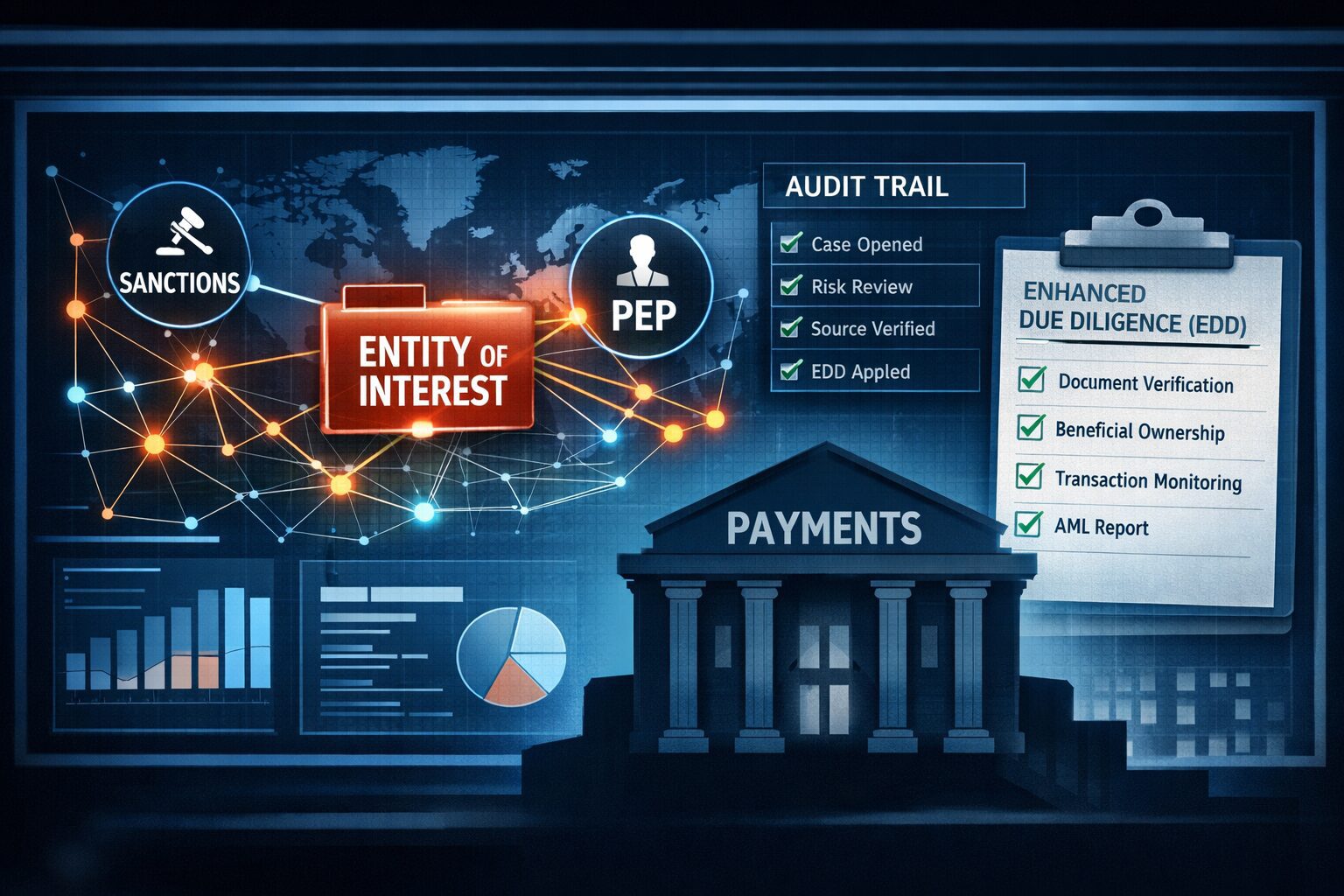
OpenSanctions is widely used in screening workflows to surface sanctions targets, PEPs, and other high-risk entities across many public sources. Being flagged as an “entity of interest” is not the same as being sanctioned — but for a regulated payment institution, it is a clear risk indicator that should trigger enhanced review, source verification, and audit-ready decisioning.
Key Facts
- OpenSanctions is an aggregation + normalization layer for sanctions, PEP, and related risk datasets, built to support investigative and compliance screening.
- The OpenSanctions API (“yente”) is designed for search/match against entities (people/companies/vessels) including sanctions subjects and related risk entities.
- “Entity of interest” is a broad risk taxonomy used in due diligence contexts (not a legal designation by itself).
- The key compliance point: the underlying source matters (which dataset, which authority/public record, which allegation or linkage). OpenSanctions helps you find the needle; it does not automatically prove the needle is real.
Short Narrative
“Entity of interest” is essentially a screening alert category. It tells you: “This name (or linked identifiers/relationships) appears in one or more datasets that are relevant for sanctions/AML/PEP/adverse-risk screening.” OpenSanctions’ core function is to aggregate, clean, standardize, deduplicate, and export watchlist-style entity data so that investigators and compliance teams can query it consistently.
In other words: it is infrastructure for risk discovery — not a court ruling, not a regulator’s finding, not a conviction, and not automatically a sanctions designation.
Extended Analysis
1) What the label does—and does not—mean
Does mean:
- The entity has been captured in a structured risk graph used for screening (sanctions, PEP, and related risk entities).
- There may be aliases, identifiers, and relationships (directors, ownership links, addresses, intermediaries) that help connect the entity to other known risk nodes.
Does not mean:
- “Sanctioned” (legal designation)
- “Proven misconduct”
- “Regulator enforcement action”
- “Prohibition to do business”
2) Why this matters more for a regulated payment institution
For a regulated PSP/payment institution, the compliance expectation is not “ignore until proven.” It is:
- Identify relevant risk signals (screening)
- Verify the underlying source (which dataset and why the entity appears)
- Assess exposure (customers/merchants, counterparties, corridors, beneficial ownership, agents, nested relationships)
- Decide and document (EDD, monitoring uplift, restrictions, exit, SAR/STR consideration where applicable)
OpenSanctions fits exactly into the identify/verify stages because it’s built as a search/match layer for watchlist-style entities and connections.
3) What “good” handling looks like (audit-ready)
If a regulated payment institution (or its key principals) shows up as an “entity of interest,” a defensible response usually includes:
- Pull the entity record and pin the exact sources/datasets driving the match.
- Confirm identifiers (registration numbers, addresses, officers) and check for false positives.
- If the source is adverse-risk/PEP/sanctions-adjacent: apply EDD proportionate to the signal (not blanket de-risking, but not handwaving).
- Create a clear decision memo: match rationale, source reliability, mitigations, monitoring plan, and review cadence.
Actionable Insight
If you are a compliance officer, auditor, correspondent bank, or regulated partner: treat “entity of interest” as a triage trigger, not a verdict. The standard is source-level verification + documented risk decisioning — because that’s what supervisors ask for when an alert becomes a regulatory question.
Call for Information
FinTelegram is mapping how risk signals propagate through payment rails. If you have primary documents (bank/PSP correspondence, KYC/EDD outcomes, termination letters, scheme onboarding packs, acquiring/merchant IDs, gateway domains, or regulator communications) showing how “entity of interest” flags were handled in practice, submit securely via Whistle42.com.