



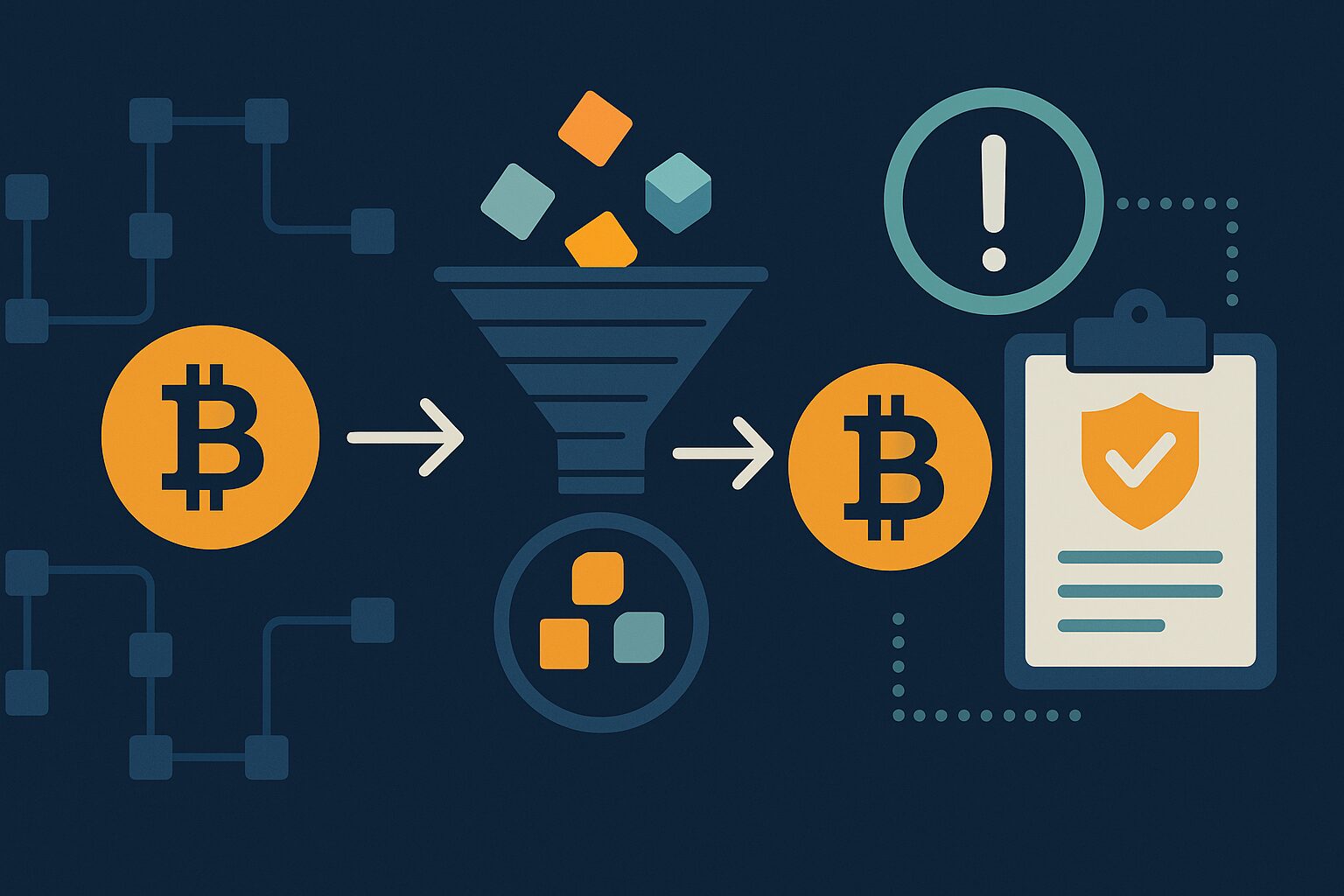
Bitcoin wallets that interact with certain privacy protocols are increasingly treated by exchanges and analytics providers as “high-risk” – even when there is no proven wrongdoing. This reflects a wider shift: in today’s regulatory environment, mixers are no longer just a niche privacy tool, but a core AML/CTF concern. Andjela Radmilac published a nice piece on this subject recently.
1. Mixers in simple terms
Mixers (or tumblers) are services or protocols that:
- Take in crypto from many users
- Shuffle or transform the funds
- Return coins that are harder to link to the original sender
There are two broad types:
- Custodial mixers – an operator takes custody of coins, pools them, and sends back “clean” outputs.
- Non-custodial mixers / CoinJoin tools – users keep control of their keys while a protocol builds a joint transaction with many similar inputs and outputs.
The goal is transaction privacy; the side-effect is that law enforcement and regulators see them as deliberate obfuscation infrastructure.
2. UTXOs and why Bitcoin is transparent
Bitcoin uses a UTXO model (Unspent Transaction Outputs). Each coin you hold is one or more UTXOs with a fixed amount and a full on-chain history:
- Every UTXO can be traced back through each spend
- The entire graph of transactions is public and permanent
Blockchain analytics firms cluster addresses, identify known entities (exchanges, darknet markets, mixers) and score wallets and UTXOs by their exposure to illicit activity.
In other words, Bitcoin is pseudonymous but highly transparent – exactly why mixers emerged.
3. The legal and regulatory view
Across major jurisdictions, the trend is clear:
- United States: FinCEN treats custodial mixers as money transmitters subject to full BSA AML/KYC obligations. OFAC has already sanctioned specific mixer protocols and addresses in the past. Operating or servicing a mixer without compliance can trigger criminal and sanctions exposure (Source: FinCEN).
- European Union: Under the new AML package and the upcoming AMLA, crypto service providers are “obliged entities.” Centralized mixers are seen as unlicensed financial intermediaries; coins linked to mixes or CoinJoin often receive high risk scores in KYT (Know Your Transaction) systems and trigger enhanced due diligence or outright blocking (Source: EU Council).
- Global standards (FATF): Mixers collide head-on with the Travel Rule and risk-based AML expectations. Even where there is no explicit ban, interaction with mixers is treated as a material risk factor (Source: AML Watcher).
4. Blockchain transparency and modern KYC/AML tooling
Contrary to popular belief, blockchain is not a shadowy black box. From a compliance standpoint, it is often more transparent than traditional banking:
- Every transaction is public, timestamped, and immutable.
- Analytics providers (Chainalysis, TRM Labs, Elliptic, etc.) map addresses to known entities, identify obfuscation services, and generate risk scores for UTXOs and wallets (Sources: Chainalysis, yellow.com).
- These tools integrate directly with exchange and bank monitoring systems to:
- Auto-block known illicit sources (sanctioned wallets, darknet markets, ransomware addresses),
- Flag mixer exposure and cross-chain obfuscation,
- Support SAR filing and law-enforcement investigations.
For law-enforcement, as one practitioner-oriented guide notes, blockchain analytics now allows officers to follow the trail from crime scene to cash-out venue in a way that is difficult to replicate with physical cash (Source: ACFS)
This is exactly why mixers have attracted so much attention: they are one of the few tools that try to reverse this transparency.
5. Implications for compliance and users
For compliance teams at exchanges, brokers, and custodians:
- Define a written policy on mixer exposure (direct and indirect).
- Use professional KYT / blockchain analytics, but tune thresholds and document decisions.
- Prefer enhanced due diligence over automatic de-banking where proportionate (proof of funds, source-of-wealth checks, ongoing monitoring).
- Coordinate sanctions, AML, and fraud views – mixer exposure tied to sanctioned actors is a separate category of risk.
For users, the key message is simple:
Blockchain is no longer an “anonymous escape hatch.” It is one of the most transparent financial systems ever built – and modern KYC/AML tools can see much more than most people assume.
In this environment, using mixers purely for privacy may still be lawful in many places, but it comes with clear and growing compliance consequences.